Jocke's body is discovered frozen in the ice
Let the Right One InJocke's body is discovered frozen in the ice when Fernando Avila, supervising a group of children on a skating outing, comes upon the remains near Kvarnviken Bay. The discovery turns a four-day disappearance into a confirmed death and reveals circumstances suggesting that someone tried to conceal the body. For the children who find it, the ice is no longer simply a place to skate; for Jocke's friends, the discovery makes the possibility of murder concrete.
Background: A Disappearance Without an Answer
Jocke had been missing for four days. In his absence, Lacke had become less able to manage his already precarious circumstances: he was drinking more and had no money left for food. Morgan regarded the disappearance as strange but saw no reason for despair, imagining that Jocke might simply have gone away and would eventually return. That casual speculation shows how little the group knew, and how readily uncertainty could be filled with ordinary explanations.
The discovery also occurs in a community recently primed to read violence through public rumor. Blackeberg is described as having little meaningful local past: its new apartment buildings stand where forest once stood, and even its scattered historical traces seem disconnected from contemporary life. The earlier Vällingby murder had been turned into newspaper stories, photographs, candles, and speculation, but the killer remained unseen. Jocke's discovery offers a different kind of evidence: not a phantom likeness or a rumor, but a body whose condition invites investigation.
The Discovery on the Ice
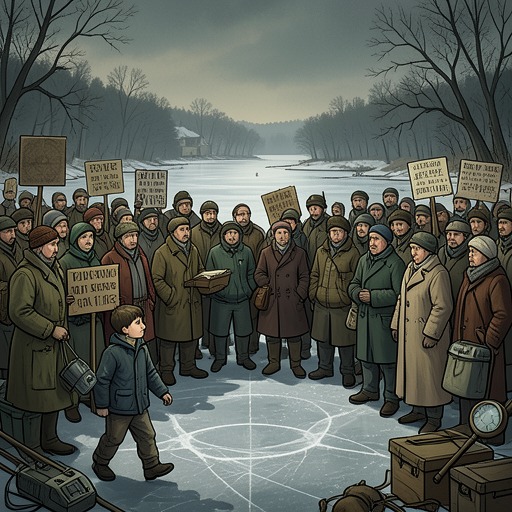
While skating, Fernando Avila notices a group moving toward what appears to be an opening in the ice. He sees a stick swung and a boy fall, then hears a howl. He starts toward the older children, but a scream from the younger group he is supervising makes him turn back. He judges that the older boys may manage without him; his own charges are younger and need his attention. The choice places him at the scene when the discovery becomes visible.
A child points to a lump embedded in the ice. On closer inspection, Fernando Avila recognizes that it is a human head, with only the top and forehead exposed. The boy who had been sent to urinate nearby is sitting several metres away, sobbing and explaining that he ran into it. The other children are so shocked that they seem unable to move. Fernando Avila blows his whistle twice, stops their screams, and directs them off the ice. A fifth-grader remains behind, bent over the discovery; Fernando Avila summons him to join the others on shore.
Once the children are safely on land, Fernando Avila tells a woman who has come down from the hospital to call the police and an ambulance. He counts the children and realizes that the boy who encountered the remains is still alone on the ice. He skates back, lifts the child by the armpits, and carries him to shore as gently as a fragile package. The practical sequence—counting, clearing the ice, calling for help, and returning for the boy—makes the adult's care part of the scene's immediate response, even as the discovery overwhelms the children.
Identification and the Evidence of Concealment
The news reaches Jocke's circle as a terse confirmation that he has been found. Later, Larry recounts what happened near the hospital: police and an ambulance were present, and a fire truck arrived. The firefighters had to hack Jocke out of the ice. Larry did not identify him at first; the ice obscured his face, but he recognized the clothes when the body was brought onto land. The details make identification depend on an ordinary, familiar trace rather than on a clearly visible face.
The recovery also exposes evidence that changes the meaning of the disappearance. A rope was tied around the body, with stones wrapped into it. When the police noticed this, they began speaking over their radios, cordoned off the area, and moved spectators away. Larry understood the arrangement as an attempt to dump the body. The discovery does not identify the person responsible or establish every detail of Jocke's death, but it makes an accidental disappearance untenable. The group recognizes that Jocke was murdered; the binding and weights give the police a concrete reason to treat the site as a crime scene.
Consequences and Public Meaning
For Lacke and the others, the recovery ends the hope that Jocke might simply turn up. Morgan emphasizes that the essential change is not only that Jocke has been found, but that they now know he was murdered. That knowledge alters the stakes for the group: a friend's unexplained absence has become violence that may concern them directly. The conversation shifts from guessing where Jocke went to the implications of a crime and the workings of the Swedish judicial system.
The event also contrasts with the earlier public fixation on the Vällingby murderer. The newspaper's account of that killing had revived interest in an otherwise ordinary hollow, while the absence of a photograph of the killer left the crime without a visible perpetrator. Here, the body itself becomes the center of attention, and the rope and stones direct attention toward concealment. Jocke's discovery thus converts private worry into public evidence, while leaving the central human question unresolved: who killed him. The ice reveals enough to change what the living believe, but not enough to restore Jocke's voice or name his killer.